
click here to download http://www.mediafire.com/?7ctpszs3pw7k8m5
Protection of Privacy on the Internet
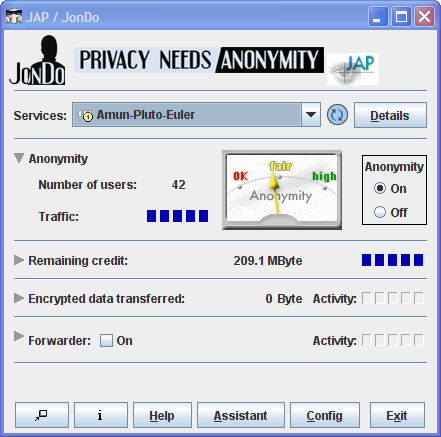
JAP (called JonDo in the scope
of the commercial JonDonym anonymous proxy servers - AN.ON remains free of charge) makes it possible to surf the internet anonymously and unobservably.
Without Anonymization, every computer in the internet communicates using a traceableAddress. That means:
- the website visited,
- the internet service provider (ISP),
- and any eavesdropper on the internet connection
Outages and maintenance times
We cannot guarantee our services (mixes, infoservice, website, download, etc.) and would like to apologize for any inconvenience caused due to system down time.
- Because JAP is a research project, it is continuously being further developed. Nevertheless, we attempt to offer a stable, downloadable version at all times, and to keep the service available.
- At the moment, the web servers and infoservices are run by universities and other public infrastructures and are free of charge for the user (even though a lot of extra data traffic is produced). Unfortunately, power supplies or data networks sometimes fail or are switched off for maintenance. We will try to keep you informed in the 'News' column on this website about planned maintenance but in case of an unforeseen failure in the university network, we are powerless.
- Mixes and Mix Cascades, respectively, are operated by external organisations, which are independent from the project itself. We may inform the operators about outages, but we are unable to correct Mix failures ourselves, and typically cannot find the cause, either.
Architecture of the Anonymization Service
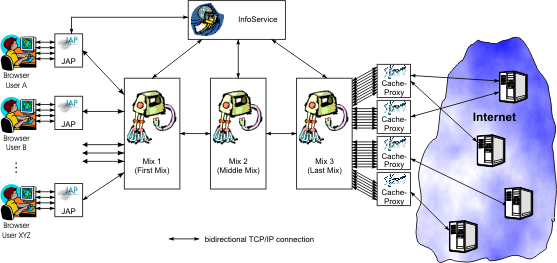
The structure of the JAP anonymization service is shown schematically in the following diagram. It consists of the following components:- JAP Client program installed on the user's computer.
- Mixes Anonymizing intermediaries which mix the data streams of various users together.
- InfoService A separate service which provides meta-information about the available mixes (that is, mix cascades), number of users currently using the mix cascades, and the current load on the mix provider.
How It Works
When you start the JAP client program, JAP first connects to the InfoService to check if the program version is still current. If the version of the program is no longer compatible with the software of the mix, the user is automatically offered a program update, since otherwise the JAP service could no longer be used.In the next step, JAP registers with the first mix station of the chosen mix cascade. A permanent network connection between JAP and the first mix station remains until logoff.On installation of JAP, the user already configured the web browser so that each packet of data sent goes through JAP instead of directly to the internet. JAP encrypts the data and sends it to the first mix station. The first mix station then mixes the data with that of other users and sends it to the second mix station which passes it on to the third mix station which decrypts and sends the data through a cache proxy to the internet.Each mix carries out cryptographic operations on the message so that the JAP-encrypted data is only readable when it's gone through the proper mixes in the proper order. That way it's insured, that an eavesdropper either only receives unreadable (encrypted) data or can no longer determine the sender. In order for it to work correctly, only one mix in the cascade need be trusted not to inform the eavesdropper as to the method of message mixing. Here is a description of the exact method of encryption.

No comments:
Post a Comment